One of the most common assumptions in newer construction is that a new home means a new community. That isn’t always the case. In areas like Ave Maria, many communities are already a decade or more into development, with some dating back to 2007 and others developed in 2013, 2015, 2020, and continuing into 2026. Homes may still be selling as “new,” but the community itself—its infrastructure, amenities, and financial history—may be 10 to 20 years old. That distinction matters.
In communities with that level of age, long-term costs are no longer theoretical. Roofs, roads, exterior painting, and shared amenities are all moving closer to replacement cycles. The question is no longer if those costs will occur—but whether they have been planned for.
This is where documentation becomes critical. In these situations, a reserve study is one of the most important documents available. It outlines what components require replacement, when those replacements are expected, and how much should be set aside over time. Without it, there is no structured, forward-looking view of long-term obligations.
If a reserve study is available, it should be reviewed carefully—not just for what is included, but for whether all major components of the community appear to be accounted for. If it is not available, that absence becomes part of the analysis and shifts the focus to other documents. In those cases, audits—especially when comparing older and more recent versions—become a key source for understanding how the community has been funded over time, whether contributions are keeping pace with expected costs, and whether the scope of what is being maintained is clearly reflected in the financial data.
To put this into perspective, consider something as straightforward as road resurfacing. Based on a typical cost range of $35 to $70 per square yard, a standard 1-mile paving project for a two-lane road (approximately 24 feet wide) can cost roughly $500,000 to $1,000,000 depending on conditions. Costs like this are not unusual, and they are not optional—they are part of maintaining the community. The question is whether those types of expenses are clearly accounted for in the financial structure.
Other common capital expenses follow similar patterns. Exterior painting of buildings can range from tens of thousands to several hundred thousand dollars depending on size and scope. Roof replacement projects across a community can reach into the millions. These are not unexpected costs—they are planned costs when properly documented.
If the community includes a golf course, this becomes even more important. Golf facilities carry their own long-term capital requirements, often supported by a smaller group of members compared to the overall community. Typical renovation costs for an 18-hole course can vary widely—for example, bunker renovations may range from $500,000 to $750,000, greens reconstruction from $1,200,000 to $1,800,000, and combined greens and bunker projects from approximately $1,700,000 to $2,550,000, with more extensive renovations exceeding those ranges. If you plan on purchasing a golf membership, the reserve study is critical, as any shortfall in funding or long-term planning may be concentrated across a smaller base, increasing the potential impact of future costs.
This isn’t about labeling a community as “good” or “bad.” It’s about understanding whether long-term financial planning is clearly documented. Because in communities that are 10 to 20 years into development, those obligations are already forming—whether they are fully documented or not.
The structure exists in the documents. The only question is whether it is reviewed before you commit.
Mike – Ave Advocate Founder
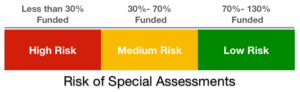
Example of Reserve Funding Levels